Tag: Caterpillars
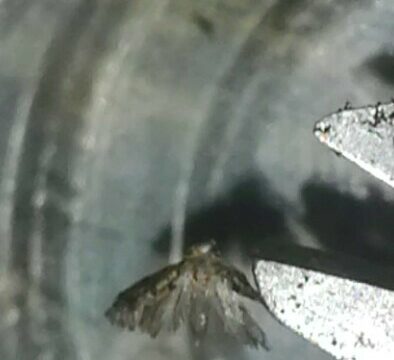
Moth with Silvery Wings is a Case-bearing clothes moth
“Is this a case-bearing clothes moth?” asks this reader in her submission regarding the silver moth pictured below. “I’m in Georgia. Thank you for your time.” Now, while we are in the business of identifying the worm-like offspring of insects, we are not the best people to ask about adult insects, so we will have to warn our reader that the information and advice we provide may not be the most credible she could find. With that said, we will do our best to identify this organism and help her. With that said, our opinion is that she has already done the bulk of the work for us, because this does indeed look like a case-bearing clothes moth.

Black Worm with Curved Back is an Inchworm
“What is this guy?” is all Brooke asks in her submission regarding the black, worm-like creature pictured below. It has an arched back and bulbous head, which tells us that this is an inchworm. Usually it is much harder to identify organisms without more context, or without a clearer photo, but the shape of this creature is so specific to inchworms that we knew it had to be one. Inchworms have legs at the front and back of their body, which forces them to curve their back in this way as they ‘inch’ their way forward.

White Worms with Dark Heads in Horse’s Water Bucket May be Larvae
“I found these small, white worms in my horse’s water bucket in the barn”, writes Jennifer about the organisms pictured below. “I have seen them hanging from a thin thread they weave in his stall before. I am trying to identify them to make sure they aren’t toxic to him if he did ingest them. Thank you in advance.” First things first, we have to make clear that, given Jennifer’s concern for her horse’s health, any suggestions we make as to the identity of these worms should only be considered in light of these organisms being deemed non-threatening to the horse by a veterinarian. Since we are not medical professionals, we are neither qualified nor legally able to identify parasites or other organisms that directly impact the health of humans or pets, as doing so is tantamount to diagnosing their medical issue. So, we recommend that Jennifer asks a vet to check her horse and inspect the worms to see if they are a threat.

White Segmented Worms are Clothes Moth Caterpillars
“What is this?” is all Kelly Jo writes about the segmented, white worm-like critters pictured below. It looks to us like the creatures are on a bed post, but that is mere speculation based on the little we can make out from the photo. Without more context, it will not be possible for us to give an exact identification, because the physical characteristics of this creature are so commonplace among worm-like creatures that it could be any number of things. With that said, we do think it is some type of insect larva (given the brown head and segmented body), and we will list some of the most likely creatures it could be, provided Kelly Jo found the creature in her home.

Tiny Worms in Baby’s Cot are Inchworms
“These teeny tiny worm-type things have suddenly appeared in our baby’s cot!” writes Kristin in her submission regarding the segmented creature with the bulbous head pictured below. “They look like bits of dirt initially, but when we looked closer they are moving! Could they be inchworms? And is this common in a babies cot? Thank you.” Based on the great photo Kristin sent in, as well as her keen eye for caterpillars, we can confirm that this is indeed an inchworm. Firstly, and most importantly, inchworms are not harmful to babies, or to grown adults for that matter. They are caterpillars of moth species which are endemic to North America, and they are characterized by the placement of their legs (at the front and back) which makes them arch their back as they walk.

Segmented Brown Worm in Gutter Looks Like a Hornworm
“We live in the east San Francisco Bay Area and while on a walk, my daughter and I caught sight of these little guys crawling in a gutter area with about 1-2”of runoff water in front of our neighborhood houses”, writes Chrissy in her submission regarding the segmented, brown, worm-like critter pictured below. “There are trees above a few spots, and upstream, no trees. They are about an inch in length and seemed to resemble caterpillars, but we’re a bit flatter. They’d walk around underwater and when resting, typically had one end up floating at the surface of the water. I’m attaching two photos as we are curious about what they are! We’re hoping they’re not leeches. Thanks so much!” Of the two photos, we included the clearest one, but unfortunately, it is still difficult to discern the smaller details of the critter’s physical characteristics from this photo. Not only is the resolution not the best, but it blends in so well with the environment that it is difficult to tell which parts belong to the worm and which parts do not.

Twig-like Worm on Branch is a Stick Caterpillar
“I found this guy in Lloydminster, Saskatchewan, Canada. What can I feed him?” writes this reader about the stick-like worm pictured below. At first, we did not see what our reader was referring to. We thought it was just one long branch. But then we noticed that the twig-like object on the right did not exactly match the rest of the branch, and does look like a separate entity. We think this is a stick caterpillar, which is a larva of the peppered moth. They are not the same things as stick insects, which are not worms or larvae of any kind, but a completely different species.
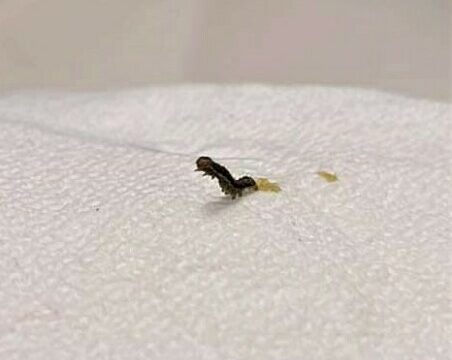
Tiny, Black Worm-like Creatures Roaming Around Apartment are Inchworms
“I live in southern Ontario and I noticed these little guys roaming around my apartment (see picture)”, writes Rachel in her submission regarding the tiny, black, worm-like creature pictured below. “Just wondering if I should be concerned. They seem to just crawl on my floor, the side of my mattress, and on my clothes. I’ve washed everything and swept and mopped the floors, but it’s tough to get them all. I’m just hoping they don’t turn into moths in a couple of weeks if I missed one. I’m pretty clean to begin with (as I live in a small studio) so I’m really puzzled where they came from. Thanks!”

Bright Green Worms Under Paving Slab Could be Fly Larvae or Caterpillars
“I found these (see attached video) underneath a paving slab, which was in the middle of a small 2m x 2m bed”, writes Sarah in her submission regarding the bright green worms pictured below. “I don’t think they are caterpillars. There was a big mass of them. Are they harmful? If so, could you suggest some options for dealing with them? I live in Cardiff, UK. Many thanks.” To start with, we have to point out that the video Sarah sent us (from which the screenshot below is taken) is really blurry, which makes it near impossible to make out any identifying information about the organisms other than their general shape and coloration. For that reason, we have to warn her that any suggestions we make as to their identity is not going to be 100% certain or accurate.
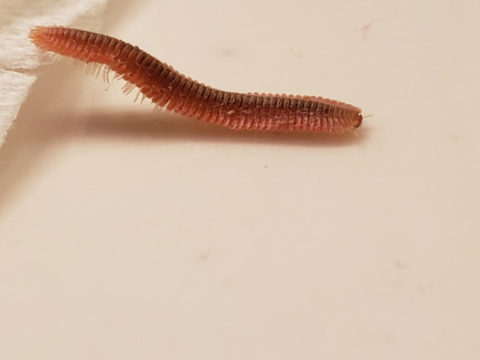
Creatures That Look Like Worms, but Aren’t
At AllAboutWorms.com, we get a lot of submissions about worms and worm-like creatures. This article will briefly outline some of the creatures that belong to the latter group. When we think of worms, we often think of an earthworm. But typically, when we find any elongated creature in the wild that remotely resembles a worm, we also assume it is one. Now, one might argue that one should not get hung up on details, but it also isn’t just a case of semantics. Knowing the difference between various species will determine how you react to a given animal, and will equip you with the knowledge of how to deal with them: are they likely to infest your home? Is your health and safety at risk? Of course, even within the category of animals that are strictly worms, you can ask these same questions, as there are thousands of worm species. But the point of this article is to identify the most common critters which are mistaken as worms, so as to educate people, but also just for fun.

Yellow and Black Caterpillar on Rock is Actually a Dogwood Sawfly Larvae
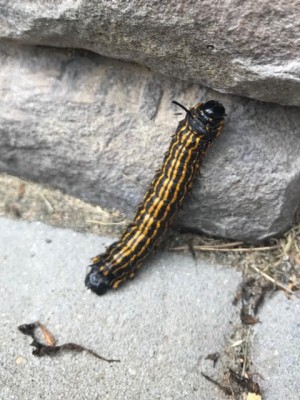
“I found this caterpillar crawling on this rock outside my garage”, writes this reader in her submission regarding the black and yellow creature pictured below. “I live in Central Minnesota. I haven’t been able to identify it and I’m hoping you can tell me what it is? Thank you!” To start with, we want to thank our reader right back for this absolutely incredible photo! It is photos like these that make identifying the organisms we are asked about so much easier. Besides, they make a wonderful addition to our library. And because of this, we can indeed tell our reader what this is. This is a dogwood sawfly larva.

Spiky, Black and Orange Caterpillar is an Acraea Butterfly Caterpillar
“I found this caterpillar in my garden (Western Cape, South Africa), but have had no luck identifying it”, writes Bradley in his submission regarding the striking, spiky, worm-like creature pictured below. “I tried the Seek app and it identified it as a Crimson Patch, but the colors don’t seem to match in any pictures I’ve seen. It is around an inch long and has distinct orange and black bands on its body. Is it indeed a Crimson Patch or is it something else?” Firstly, we want to compliment Bradley on the fantastic photo he sent in. It will be a welcome addition to our library of caterpillar and worm photos. Secondly, we also want to compliment him on doing his own research and coming up with excellent questions.

Small Worm with Needle Tip Could be an Inchworm
“I have looked through your site and can’t find exactly what I’m having a problem with”, writes this reader regarding the tiny critter pictured below. “They look like worm-type things, but they are as small as a needle tip, probably one millimeter long, and they seem to appear out of nowhere. They don’t seem to move while I watch them, and one minute out of nowhere they appear on my body. I’ll include pictures for you below.” Right off the bat, we will have to point out that, because of how tiny the worm is, and how blurry the photo becomes when we try to zoom in on it, we will not be able to provide an identification that is 100% certain or accurate. We understand that, given the minuscule size of the worms, it would have been extremely difficult to photograph these creatures.
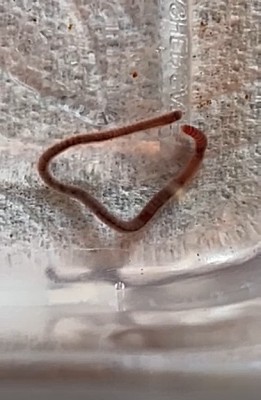
Clear Pink Worms Scaling Home could be Earthworms or Caterpillars
“I have had these skinny, slimy-looking worms that are sometimes a pink color and a translucent pink,” writes this reader in her submission. She continues to say that the worms “have basically taken over the outside walls and doors of [her] house.” She lives “in the Heartland, Florida area”, and explains that the worms were found after “all the rain the past couple months. What are they?” She does not attach any photos to her submission, so we must note that any identifications we make here are merely educated guesses, and are not made with 100% certainty or accuracy.
How to Distinguish Oak Worms from Asp Caterpillars
“How do you distinguish oak worms from asp caterpillars?” is all this reader writes in her submission. She does not attach any photographs, but in this case, that’s not necessary. The two creatures she asks about are moth species, and they are actually very different. Sure, they are both defoliators, and eat leaves from the respective trees they are named after, but just appearance-wise, they are night and day, and are very easy to distinguish. So, in essence, our reader made our job really easy for us.
Tiny, Red Worm on Toilet Paper Could be a Caterpillar or Bloodworm
“What is this in the video?” asks this reader in his submission regarding the tiny, red, worm-like creature pictured below. “Pest was very small, probably less than a centimeter. Was found on a roll of toilet paper. In the image, that’s a single square of Charmin it is on for perspective.” Now, despite the minimal context provided, there are some things to unpack here. Firstly, we will not be able to give a concrete answer as to what this creature is, simply because the photo and video provided are way too blurry to pick out the details of its physical characteristics. The most we can do is provide some educated guesses as to what it could be. Secondly, while the video is blurry, it does tell us something about how the creature moves. Its seamless gliding over the surface of the toilet paper tells us that this creature has legs, and is not a worm, but probably some type of larva (if not a millipede or centipede). Thirdly, our reader explicitly states that this is a pest, but does not elaborate on that point. For that reason, we will not assume that it has to be a pest when we suggest possible identifications.

Green Worm Dangling From Cap is an Inchworm
“What is this thin, small, brow/tan, almost greenish inch worm?” writes this reader about the worm-like organism pictured below. “Found it dangling off my cap on a some sort of thread I think, it moves pretty fast. From the US.” Thanks to our reader’s excellent photo and video, but mostly the fact that she names the organism herself, we can confirm that this is indeed an inchworm. Inchworms are any caterpillar of a group of moth species found in North America. They are all characterized by their number and placement of appendages: legs at the front and back, but not in the middle. Due to how the legs are positioned on the body, the inchworm moves as it does in the video: by reaching for something to grab onto with its prolegs, then arching its back while the hind legs catch up.
Fuzzy-looking, Black worms Invading Home are Caterpillars
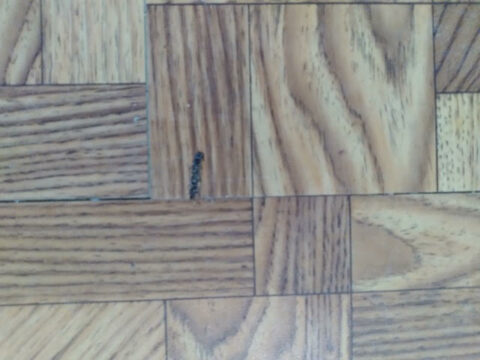
“I’ve found small, black, almost fuzzy-looking worms on and around the entrance door, the concrete patio at the doorway, and in every room, mostly on the floor!” exclaims this reader in his submission regarding the creature pictured below. “Seems I’ve crushed about a million, flushed a bunch, washed them down the shower drain, sprayed home defense and even peppermint mixed with water, but can’t get rid of these pests! What are they and what can I do to keep them gone? I live in a basement apartment in North-East TN, near the VA., Tennessee state lines! Thank you for taking my question!”

Segmented Worm on Daughter’s Leg Could be a Caterpillar
“This was stuck to my daughter’s leg after a day of being outside in the garden”, writes this reader about the segmented, brown creature pictured below. “It didn’t bleed when I pulled it off but was definitely stuck to her. It did curl up when I pulled it off. We are in Connecticut. What is it?” Right away, we have to point out that we will only be able to make an educated guess as to what this creature could be. The reason for this is that our reader’s photo is low resolution and was taken quite far away from the creature, meaning that when we zoom in to try and get a better look at the creature, the details become blurry.

Gray Worms Swarming Laundry Basket are Newly-hatched Caterpillars
“What is this?” is all this reader asks about the minuscule, gray, worm-like creatures pictured below. They seem to be swarming a laundry basket. Despite the lack of context, and the low resolution photo, we do have a couple of suggestions for that these critters could be. Given their gray coloration and bulbous black heads, these look like newly-hatched armyworms or American ermine moth caterpillars. It is odd that our reader found them on her laundry hamper, only because neither of these species feed on textiles, like the clothes moth caterpillar or the carpet beetle larva.