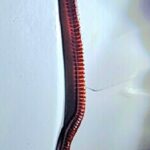
In the spring, you may be seeing brownish black worms that curl up in a circle. You’ll find them indoors in small quantities or, in rare cases, overwhelming numbers. These small worms are most likely millipedes, characterized by their common defense action: curling into a circle. The smallest brownish black “worms” may be the result of a very recent hatching. If they survive, they’ll grow, molt and continue to make an appearance. However, without the right environment and food, most millipedes will quickly die inside your home.
The abundance of sightings in the spring means the females have laid their eggs outdoors. They’re prolific and can produce as many as 300 eggs at one time. Small batches of eggs are distributed in the ground litter, with youngsters emerging about three weeks later. In some regions, fall is another opportunity for millipedes to congregate abundantly in homes.
Millipedes also find lighted areas attractive. Homeowners report that lights around swimming pools and other nighttime attractions will draw these arthropods into the area. Remember, these small, brownish black “worms” are not insects at all; but do feed on many insect pests.
Are these brownish black worms harmful?
In general, millipedes are harmless, unlike their centipede counterparts, many of which can bite and sting. All millipedes, when disturbed, can emit a foul liquid that has the potential to irritate sensitive skin. The chemical emission can also become more serious if it reaches a human mouth or eyes. Larger, tropical millipedes, which are sometimes acquired as pets, may produce heavier concentrations of chemical defense. Hand washing is recommended after handling any millipede although the staining liquid may take a few days to disappear entirely. Otherwise, they won’t invade pantries or cause damage to home structures. They also do not carry diseases or munch on clothing.
Millipede sizes can range from about one-quarter of an inch up to one inch in length. Larger tropical millipedes can grow up to 12 inches long. They move rather slowly on short legs. Almost every body segment features two pairs of legs (as opposed to centipedes, which have only one pair per segment). No matter how large the millipede, though, they typically have far fewer legs than their nickname “thousand-leggers” suggests.
In the great outdoors, millipedes are beneficial creatures. They thrive in damp leaf litter and other debris, breaking it down while consuming pesky insects at the same time. When you see a home invasion, it’s usually because there is a population explosion outside. Millipedes are usually brownish black or a deep red-brown in color while centipedes can present many interesting shades. Millipedes thrive exclusively in the outdoors while some “house” centipedes can survive in or out.
Treating and spraying for millipede invasions is relatively useless. Cleaning up wet debris around the home can eliminate overpopulation. Caulking cracks and blocking drafty areas around doorways and windows will also help. Since millipedes feed on household pests, you can apply insecticides to eliminate those species, which will reduce the attractions of millipedes to your space.
All About Worms is always free, always reader-supported. Your tips via CashApp, Venmo, or Paypal are appreciated! Receipts will come from ISIPP Publishing.
CashApp us

Venmo us

Paypal us

You might also find these guys interesting!
 Big Purple Worm in Puddle is an Earthworm
- Mangled Red Worm in Toilet is a Tiger Worm
- Long Gray Worm with Black Stripe is a New Guinea Flatworm
- Grayish-green Worm with Big Eye Spots is an Elephant Hawk Moth Caterpillar
- Worm-like Creature with Antennae in Pool is a Centipede
- Skinny Light Brown Worm Appearing Next to Dead Spider is a Horsehair Worm
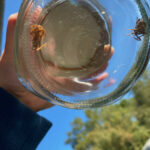
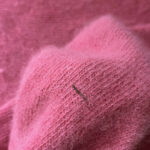
- Segmented, Brown Worm-like Critters on Sweater are Millipedes
- White Worms With Brown Heads in Light Fixture are Beetle Larvae
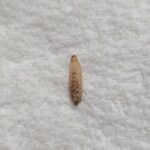



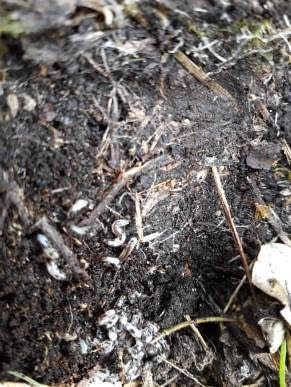
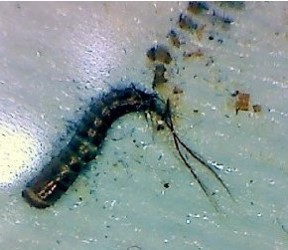

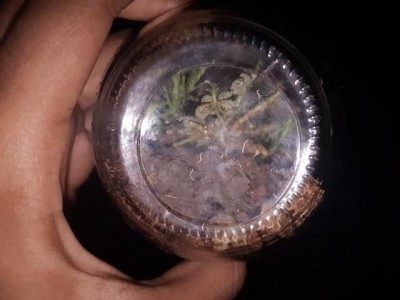



the ones I have are black and about inch long. no longer than an inch. they do curl up if disturbed but I spray them with alcohol and they die. But every day they are out there on my porch. I saw over 50 one day and stopped counting them.
Laura S.
It is late spring of 2021 and I have 100’s of worms ( think they are millipedes?!) that come from outside to inside the garage to the kitchen and the back door to the den area every night. I See about 20 on the front porch and on the opposite end of the house . I hate them ! I have never seen them like this until this year ! I’ve sprayed around the house myself with poisons and powders . The (D) earth powder had worked for a while until it rained . Last night was the worst ! All I had was strong vinegar which I sprayed at the entrances and brick walls outside. The ones that came in curled up and died , but the ones outside tuned around and went the other way! I hate dealing with them , up nearly all night ! Is this part of the end times pestilence?!!! Help!
Mine are most likely the harmless types of millipedes, They curl up when I go near them and they are the size of my pinky finger. I don’t “Want” To kill them, But I am terrified of bugs and worms so I usually do. Their bellies are brown when they curl up you can see so! This might be what others are experiencing so let it be known, They wont harm you but will decrease pests in your house!
I found a worn in my garden, black, with a spade shaped head, there were two worms, we killed them both, I need to know if they are dangerous, because we don’t want to kill them but we need to know are they harmful or harmless
I have one in my bedroom is it dead or not it’s been in there for a week?
Discovered some of these disgusting “worms” were coming from under my stove. Found that sticky tape trapped them. I think that one sticky tape was meant to catch mice or moths… Forgot which or when I bought this. Have now spread a long strip of tape sticky side up under the stove to stop them from traveling any further. Am now looking for the kind of sticky tape used to catch flies in sheds or barns; these may be more useful since one could stick the tape on paper & make cleaning up easier.
I live in Texas ,hondo medina texas hill country wooden area Rockies . Problem I have this small dark brown worm come and goes inside home and stinks bad order how do I get rid of this . Brick home sometime outside on walls I well see it . I spray occasionally outside . I have plants and Mulch around house ?
I live in Texas ,hondo medina texas hill country wooden area Rockies . Problem I have this small dark brown worm come and goes inside home and stinks bad order how do I get rid of this . Brick home sometime outside on walls I well see it . I spray occasionally outside . I have plants and Mulch around house ?
I have them at my front door, they pile themselves into the crack of my cement. Because there near the front door,,, I really want them gone. Not so nice to greet you! I tried 2 different bug sprays. Works for a bit but they come back. Will they hurt my new foundation? Wood, cement? How about a shot of melafion ???
Makes my freakin skin crawl. I need to get rid of them. They are indoors. If they are outdoor…fine. Indoor…not so much
Millipedes, why are they, in the scrub by my front door, and, why do they, keep coming in my house, been living here for over seven, year’s , never saw then before?
Maybe millipedes, many different types. Google millipede image & see if you can identify yours.
i have these by the hundreds in my garage here and there..they are disgusting.. how do u get rid of or control them. thanks
I’m sorry but they’re just annoying I feel bad killing them but there’s just too many
I HAVE 100’S INSIDE AND 1000’S OUT ON PATIO WITH WOOD WALL WITCH IS WET THEY JUST KEEP COMING..ANYTHING I CAN DO?? AL MURRAY