Earthworms can be a great asset to gardens. They can be beneficial to your garden, plants, and trees in several ways. They can help to control destructive termite larvae and grubs, as well as other destructive garden pests. They can also help mix the earths soil by burrowing into the ground or by writhing around in topsoil. While most earthworms are helpful, there are some that are destructive and should be eliminated. One such worm is the hammerhead flatworm (land planarian). Before you can get rid of the hammerhead flatworm, it is important to understand the nature of hammerhead flatworms and how they destroy your garden.
About Hammerhead Flatworms
The hammerhead flatworm does not help to control other pest populations as most worms do. They actually kill and eat earthworms, exclusively. The hammerhead flatworm is considered a parasite and it devours its only prey by pushing its throat outside if its mouth and snapping up any part of the earthworms body. It melts the earthworms body with an enzyme and slowly eats it until the earthworm is completely consumed.
The hammerhead flatworm can reach up to 20 inches long and its body secretes mucus from glands on the belly or underside. This makes the body slimy allowing it to move along the ground in a gliding motion. The hammerhead is native to Indo-China, but it makes its way around the world by traveling in greenhouse plants. For the most part, hammerhead flatworms can survive just about anywhere, so no one region is 100% safe. While this unique worm can survive in scorching hot to freezing climates, they may suffer somewhat in drier regions.
There are several varieties of land planarians. Two of the most common sightings are the hammerhead flatworm and the flatworm with a pointy head (instead of a hammerhead) and a dark brown body. The hammerhead flatworm is usually medium-brown in color with dark markings or stripes. Some hammerhead worms may appear gray to greenish/gray as well. All types feed on earthworms, so beware.
Hammerhead flatworm sightings are common in the early morning hours, especially after a hard rain. They are nocturnal however, and they love wet surfaces. This means that they will stick to just about any surface that’s wet or moist, as well as on tree branches and trunks.
How to Get Rid of Hammerhead Flatworms
If you have a hammerhead flatworm infestation, there are several ways to control and/or kill populations. The first thing to keep in mind is if you attempt to chop them up or even smash them, the pieces will only regenerate into new hammerhead flatworms. So, it you chop the flatworm into 7 pieces, you will end up with 7 new worms! Hammerhead flatworms must dissolve completely in order to get rid of them. Effective treatment methods include: salt, vinegar, and citrus oil. These products must be applied directly to the flatworms in order to be effective. Spreading them around the soil or areas where you the worms have been spotted won’t dissolve these parasites completely. You can use a spray bottle for the vinegar and citrus oil methods and you can simply pour the salt over the worms to dissolve them. Good luck!
All About Worms is always free, always reader-supported. Your tips via CashApp, Venmo, or Paypal are appreciated! Receipts will come from ISIPP Publishing.
CashApp us

Venmo us

Paypal us

You might also find these guys interesting!
 Do Palm Tree Borers Infect Humans?
- Can Carpet Beetle Larvae Bite People?
- Yellow Worm Dangling from Silk Line is a Clothes Moth Caterpillar
- Black and Yellow-winged Bug is a Jarvis’ fruit fly
- Dried-up, Red Worms Near Plant Pot Could be Earthworms or Bootlace Worms
- Green and Black Organisms Likely Connected to Weevils or Leafcutter Bees
- Black Worm in Bathroom is a Drain Fly Larva
- Twig-like Worm on Branch is a Stick Caterpillar





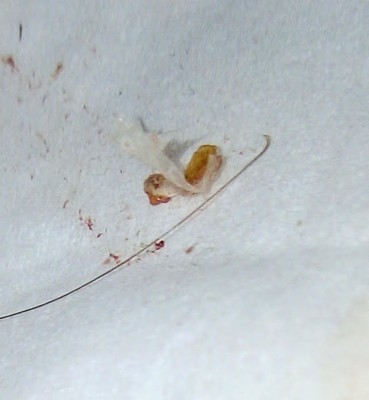



Is there any way to kill Hammerhead flat worms in large areas, such as lawns. Is there a treatment to apply to a lawn??
Thanks
My son used the “salt” gun we use for killing flies to kill those nasty flat worms. It was very fast & affective way to be rid of the worm. We bought the salt gun at a local retailer. It looks like a plastic toy gun.
I’ve used alt on these guys just like we do on slugs but I usually ask my kids to do that. Of course they like to use the whole container of salt. So one day before I “knew” about it I used vinegar (6%) I had in a squirt bottle I had been using on mildew and algae recently, (I was out of salt) and within a couple of minutes the flat worm was mush. So now I kill two birds with one stone relocating new found flatworms to our algae ridden driveway and give em a squirt. Of course I hose it down later, that mush between your toes does not clean up easy.
I am legally blind and have a small service dog. I found a arrowhead flatworm on my carpet and thought it came from my canine. When I found out we were bringing them in from outside I was almost as upset. Isn’t there ANYTHING that eats these things. I cannot see them outsede. I could on my light colored carpet.
You can kill the land planarian very effectively, and organically using concentrated lemon juice. I use water:lemon at a 2:3 ratio. You can use 1:1 but 2:3 works faster.
how profusely do these hammerheads reproduce?
Manuel