Category: Marine Worms

Translucent Worms with Squiggly Red Insides Under Plant Pots are Sludge Worms
“I found these worms under my plant pots in the balcony garden”, writes this reader in his submission regarding the clear worm with red entrails pictured below. “They are hair-thin and they move in water at a good speed with snake-like movement. When I took a picture and zoomed in I found they have dots at one end of the body — the tail end I would assume. They look really frail, thread-like alarmist hair like. Three-to-five centimeters (1.2-2-inches) long and there’s quite a few of them in wet places under plant pots, fallen leaf debris, etc, after two days of rain. I wanna know if these are parasitic. And how to kill these without killing my plants. I’m from Maldives.”

Black Maggot-looking Creatures Living in Creeks Could be Black Fly Larvae or BSFL
“What are the little black maggot-looking larvae that are in creeks?” asks Crystal in her submission. “They live under leaves and they are only in creeks once a year. I used to fish with them but I don’t know what they are.” Crystal does not attach any photos to her submission, which makes it much harder to narrow down the list of suspects for this creature that Crystal is searching for. Unfortunately, there are a lot of worm-like creatures that fit Crystal’s description. They could be anything from millipedes to rosemary beetle larvae to leeches. With that said, we have tried to narrow down our educated guesses to two species that are more “maggot-looking” than the others, and which tend to live near creeks and streams.

Bristly, Ovate Creature Found in Bathroom Look like Sea Mouse Larvae
“I’m based in the UK and found this in my bathroom”, writes Angela in her submission regarding the grayish, ovate creature pictured below. “I’ve found three so far and cannot find out what it is. My bathroom has a ledge away from the water source; one was found wiggling on the tiled ledge, and one was in an even more curious location: inside a clean container with some serialized items. The one pictured came from a plastic tray which I was cleaning out and, to be fair, this tray was quite dirty and had a pattern with ridges. It was about 4mm in length and didn’t appear to mind water. Is it a drain fly larva? I’ve posted how it moved on Reddit, linked below. Many thanks!” To start with, we have linked the video below that she posted on Reddit, and it is quite an interesting video. It looks like the organism is underwater, and yet the way it contracts its body and moves forward looks like it is dragging itself across a solid surface, rather than swimming.

Dozen White Worms on Sidewalk Could be Roundworms or Gordian Worms
“I found a dozen of these on my sidewalk, what type of worm are these?” asks this reader in their submission regarding the long, white, tangled worms pictured below. No further context is provided, but we do have to point out that the photos our reader sent in are just fantastic: it is this level of quality that lets us, as well as our other readers, more easily identify the organisms in the photo. It helps us identify the creatures faster, and it helps other readers identify the worms they might be dealing with. In our reader’s case, we think these could be roundworms or horsehair worms, though given the nondescript nature of the worms’ bodies, it is hard to tell for certain.
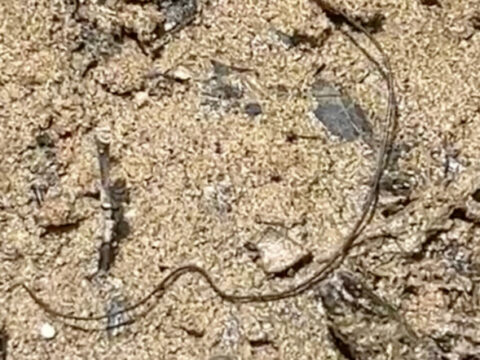
Needle-thin Worm on Muddy River Bank is a Horsehair Worm
“What is this little guy?” asks Valerie in her submission regarding the black, worm-like critter pictured below. “About 4-inches long, needle thin, in the muddy bank of a river in the Shenandoah Valley of Virginia.” To start with, we want to thank Valerie for the excellent photo and video she sent in. The video captures the sporadic, twisty movements of the worm, and the picture gives us a good sense of scale, showing us how long this worm really is. Based on this information, as well as the context Valerie provided, we think that she found a horsehair worm.

Dried-up, Red Worms Near Plant Pot Could be Earthworms or Bootlace Worms
“I have found this worm for the fourth time (found two yesterday, and one the day before), less than one metre (approximately 3.3 feet) away from my plant pot”, writes Mrs. Wood about the red, worm-like organism pictured below. “I use rainwater to water my plants. I also have a cat, which is indoors. The worm is dried up. About one centimeter in length (0.4-inches). I zoomed right in on him. I can see his funny shape, rounded ends. Even the food he was eating inside him. He is a dark red color. I hope it’s just an earthworm, but I need your advice. I’m worried that it could be some parasite. Could you please help?”
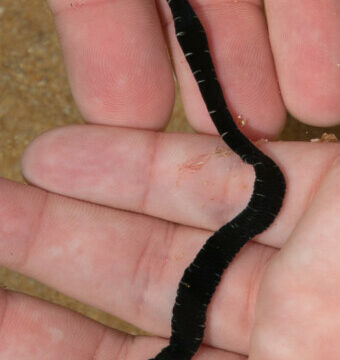
Black and White-striped Worm on Portuguese Beach is a Ribbon Worm
“Today I found this kind of worm on a beach (underwater by the rocks) and I’m wondering what it is,” writes Nuno in his submission regarding the black and white-striped creature pictured below. “Can you please help me? Thanks!” Firstly, we want to thank Nuno for the fantastic picture. The lighting and resolution are so good that we get a lot of identifying information from this photo: such as the the minute white stripes that form incomplete circles around its body, the inconsistent shape of its body, and even down to the texture of its skin (or at least, the kind of texture it looks to have). Secondly, we definitely can help Nuno given that he provided such a good photo and a vital piece of context: he found the worm on the beach.

Slimy-looking, Pinkish Worm Could be a Rat-tailed Maggot
“I pray you receive some of my emails and can help with identifying these”, writes this reader in his submission regarding the two, distinctly different-looking organisms pictured below. “I have hours of digital footage on a cheap microphone and so many pics. I live in Richmond Hill, Georgia.” Firstly, we have to point out that, from what we can tell by looking at these photos, it looks like they were taken through a microscope. We cannot know that for certain, but when we compare it to other submissions we have received where the photos were taken like that, the similarity is significant. In any case, the photos have a strange quality about them.

“Jellylike” Organism Clinging to Toilet Bowl is Possibly a Bristle Worm
“We found this clung to the toilet bowl,” writes this reader in his submission regarding the strange-looking organism pictured below. “Not sure what it is, it’s clear and jellylike. Any insight would be appreciated. Thanks.” We have to say that we have actually seen something like this submitted before by another reader, and it stumped just as much then as it does now. The center of the creature’s body seems to be transparent, while its bristles or segmentation (we are not sure what those appendages are) are visible, but only just. On top of that, at one end of its body, the appendages seem to break apart. We are curious to know how much our reader had to zoom in on the worm to get this picture.

Large Pink Worm in Toilet is a Bloodworm
“Can you tell me what kind of worm this is?” asks this reader in her submission regarding the pink, and presumably large, worm pictured below. “I found it at the bottom of my toilet. My husband fished it out and put it in a plastic container. Any help you can offer would be hugely appreciated! Thank you!” To begin with, we just want to thank our reader for the excellent photo. She also sent in more, but we opted to include only the best one. They were all fantastic though. Photos like these greatly help us identify the creatures we are asked about. And on top of that, it is far more fascinating to see such creatures in such detail.

Clump of Matter Could be Horsehair Worms and/or Eggs
“I found this in my apartment and cannot seem to find anything online that looks similar”, writes Heather in her submission regarding the clump of black and translucent matter pictured below. “Any idea what it could possibly be?” Now, we are not sure if our reader is referring to the black, hair-like objects, or the translucent, ovate objects that seem to be tangled up in the ‘hair’. In any case, we will provide options for what either object could be.

Bright Red Worm in Washbasin is a California Blackworm
“I found this bright red worm in my bathroom sink (washbasin)”, writes this reader in her submission regarding the striped worm-like creature pictured below. “1) Should I be worried? Are they dangerous? 2) Did it come from the tap, therefore possibly from the house’s water tank? Or did it come up from the drain? 3) What steps should I take?” To start with, we want to compliment our reader on the fantastic photo, as well as the great questions she asked. They are all fantastic questions to ask when finding a worm, or any kind of unknown organism. In our opinion, this looks like it could be a California blackworm.
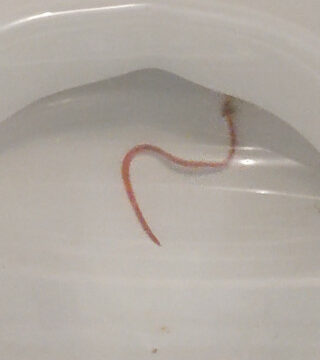
Red-striped Worm in Loo is a Bloodworm
“We found this worm in the loo this morning”, writes this reader about the long, red worm pictured below. “We have a kitten, and sometimes flush his stool. I fear this may be yet another bloodworm/earth worm question, but we wanted to ask whether you thought it could’ve come from our kitten. We live in a top floor apartment on the 4th floor in the UK.” Just by looking at the worm, we think it is indeed a bloodworm. If we did not think it was a bloodworm, we would not be able to confirm or deny if we thought it came from the kitten, as only a vet would be qualified and legally able to do so. If our reader thinks that this worm is harming his kitten, or notices that worms are found in its stool, then we recommend taking the kitten to the vet.

Gray Tadpole-like Creatures Found Swimming in Hot Tub
“My friend’s hot tub hasn’t been cleaned since May”, writes this reader about the gray organism pictured below. “Was looking at it today and there are thousands of these clear, tadpole-like creatures swimming around. I’ll attach a video and picture. I’m from Fife, Scotland.” To start with, we have to point out how blurry this photo is. Because of this, we will not be able to give a confident identification of this creature. We are only guessing that the gray object in the photo is the tadpole-like organism our reader is referring to.

Worm Covered in Sand on Mexico Beach Could be Flatworm or Sand Mason Worm
“I found this guy schlepping along a beach in Mexico”, writes this reader about the creature pictured below. “What the heck is it?” Well, we are wondering the same thing. If it weren’t for our reader stating that there was an organism in the photo, we definitely would have missed it. It just looked like a slightly raised portion of sand. For that reason, there is no identifying information in the photo, since we cannot see the actual worm. That said, it does bring to mind some possible identifications.

Thin, Black Worm in Toilet is a Horsehair Worm
“Can you help tell us what this is?” asks this reader in her submission regarding the thin, black worms pictured below. “And if it is common, or coming from one of us? And any possible ways of stopping worms in the toilet? My mum bleaches frequently and is super clean.” Despite our reader’s short submission, there are a lot of questions to be answered here. Firstly, we can definitely help our reader in identifying the worm-like creature pictured below. We think this is possibly a horsehair worm. These worms are somewhat common, though they are more common in nature than in people’s homes. They would not be coming from our reader or her mother, despite being parasites.

Transparent Worm in Drinking Glass Could be Marine Worm or Mucus
“I want to get the information about this worm, cause today I found this worm in my drinking glass”, writes Viashnavi in his submission regarding the transparent organism pictured below. “I noticed it while drinking the water, so I got scared. Then I tried to vomit, and I vomited all that I ate before too. I think it’s not harmful to my body. So can you please reply to me. I need all information about this worm. Thank you.”

Clump of Red Worms in Toilet is a Mass of Tubifex Worms
“Came home after being away for a month to find a clump of long, thin, reddish-brown worms living in my downstairs toilet in water that looked dirty”, writes this reader in Southern California regarding the worms pictured below. “Didn’t note heads on the worms or segmentation. Any help would be appreciated!” To start with, we want to thank our reader for the great photo. It was thanks to this photo, as well as the context, that we have identified these as tubifex worms. Tubifex worms, otherwise known as tubificid worms, sewage worms, sludge worms, or bloodworms, are a marine species of worms that eat bacteria and organic debris in sediment.
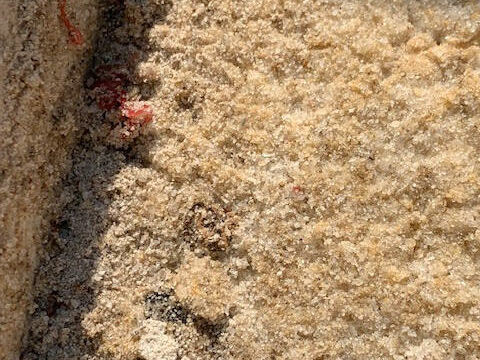
Red Worms Under Pool Pavers are Bloodworms
“We have found these worms underneath the pavers around our pool”, writes this reader about the red worms covered in sand pictured below. “Do you know if they are blood worms? Also how do we get rid of them? They seem to be pushing moist dirt up through the pavers. Thanks!” Given the color of the worms and the location they were found, we would say it is likely that these are bloodworms. We cannot say this with 100% certainty, as we cannot really see the physical characteristics of the worms, seeing as they are covered in sand. But assuming these are bloodworms, we will do our best to give our reader the information she asks for.

Red Worm in Toilet is a Blood Worm
“Is it a blood worm?” asks Almohannad about the bright red, worm-like creature pictured below. He also sends in an excellent video of the “worm [he] found in [his] toilet.” He does not provide more context than this, but based on the photo and the little context he did provide, we would say this likely is a blood worm. The term “blood worm” does not refer to any one species of worm, but is actually an umbrella term for those worm-like organisms which have a bright red color due to the excess amount of hemoglobin they produce, which enables them to sustain for long periods of time in low-oxygen conditions: like underwater. In fact, a lot of blood worm species are marine worms.